Choosing the right homeschool curriculum for gifted students is more than just moving faster through standard lessons. For parents navigating the high-stakes world of gifted program admissions, it requires a precise strategy that builds the specific cognitive skills measured by tests like the CogAT. This is not about generic practice; it is about surgical precision.
Why Your Gifted Child Needs More Than a Standard Curriculum
The pressure to select the perfect homeschool curriculum can feel immense, especially when you see your child's potential and understand the competitive nature of gifted admissions. You recognize their rapid grasp of new concepts and their deep curiosity, but the conventional advice to "accelerate" or "buy an advanced workbook" often proves inadequate. Giftedness is not just about speed. It is about depth, complexity, and a different way of processing information.
If you are an anxious parent trying to navigate this landscape, this guide provides actionable advice. We will move past generic tips to address the core challenge: how to deliver an advanced education without creating hidden learning gaps. This requires a shift away from a "more is more" philosophy to a strategy where precision is everything.
The Problem with a One-Size-Fits-All Approach
Many parents choose homeschooling to provide the personalized education unavailable in a standard classroom. The movement has grown, with approximately 3.1 million homeschool students in the U.S. during the 2021-2022 school year. Of those, an estimated 50,000 to 140,000 are gifted, highlighting the significant need for specialized resources. You can read the full research about homeschooling trends and statistics to understand this changing educational landscape.
A generic curriculum, even one labeled "gifted," is designed to fail because it cannot see your child’s unique cognitive profile. It cannot identify a micro-category weakness in a specific skill, such as understanding paper folding questions on the CogAT's Nonverbal battery, while your child simultaneously excels in verbal analogies. This creates a cycle of boredom in their areas of strength and invisible struggles in their weaker areas.
The goal is not just to cover more material. It is to build a more flexible, resilient, and analytical thinker. This requires a diagnostic approach that identifies the exact cognitive building blocks needing reinforcement.
Building a Foundation on Diagnostic Insight
The solution is to begin with a diagnostic blueprint. This data-driven foundation allows you to construct a curriculum with surgical precision. Instead of guessing, you will know exactly which cognitive skills require targeted practice. This guide will show you how to anchor your homeschool plan around developing the core abilities that gifted tests like the CogAT actually measure:
- Verbal Reasoning: Moving beyond vocabulary lists to true analogical thinking.
- Quantitative Reasoning: Building deep number sense and the ability to spot complex numerical patterns.
- Nonverbal Reasoning: Mastering spatial visualization and abstract pattern recognition.
When you adopt this diagnostic method, you transform test preparation from a stressful task into a natural extension of a rich, engaging, and truly personalized education. The next step is making the first critical decision: choosing between acceleration and enrichment.
Acceleration vs. Enrichment: A Critical Choice for Test Readiness
When mapping out a homeschool plan for a gifted child, the choice between acceleration and enrichment is a pivotal one. This is not merely a matter of teaching style. It is a decision that directly impacts your child's development of the flexible thinking required for gifted admissions tests. Getting this right is the first step toward building an effective curriculum.
What is the difference?
Acceleration means moving through the standard curriculum at a faster pace. Imagine a second-grader completing the entire third-grade math curriculum by January. While this prevents boredom for a quick learner, it often prioritizes speed over deep, lasting understanding.
Enrichment, on the other hand, is about going deeper, not faster. Instead of moving on to third-grade math, an enriched second-grader might explore logic puzzles, discover the "why" behind number properties, or manipulate geometric patterns. The objective is not to advance to the next grade level but to build a wider, more robust cognitive foundation.
How This Choice Shapes Gifted Test Readiness
For parents preparing children for competitive gifted programs, this decision is crucial. A curriculum built purely on acceleration may look impressive, but it can leave significant gaps in cognitive skills. The ability to perform fourth-grade math does not guarantee a child has developed the abstract pattern recognition skills needed to excel on the CogAT.
The most challenging questions on gifted tests do not measure mastery of grade-level content. They measure how flexibly a child can apply fundamental concepts to solve novel problems.
This is where enrichment proves its value. Enrichment is the engine that drives fluid reasoning, the very skill that tests like the CogAT are designed to measure. By focusing on deep exploration, you are building the mental agility your child needs to connect ideas in new and creative ways.
Comparing Acceleration and Enrichment Strategies
To see this in action, let's compare how each approach prepares a child for the different thinking skills required in gifted testing. The table below breaks down the core differences, helping you see which path aligns better with your goals.
| Curriculum Focus | Acceleration Approach (Doing More Faster) | Enrichment Approach (Going Deeper) | Impact on CogAT Skills |
|---|---|---|---|
| Philosophy | Cover more content at a faster pace. | Explore concepts in greater depth and breadth. | Enrichment builds the flexible reasoning skills tested by the CogAT. |
| Math | A 2nd grader learns 3rd-grade long division. | A 2nd grader explores logic puzzles and number theory. | Deep number sense (enrichment) is more valuable for Number Puzzles than procedural knowledge. |
| Reading | A 1st grader reads 3rd-grade level chapter books. | A 1st grader analyzes character motives in a grade-level story. | Understanding relationships between ideas (enrichment) is key for Verbal Analogies. |
| Spatial Skills | Not typically covered in standard curricula. | Playing with tangrams, symmetry, and 3D puzzles. | Enrichment directly builds the skills needed for Paper Folding and Figure Matrices. |
While some acceleration is often necessary to keep a gifted child engaged, a curriculum that emphasizes enrichment is far more effective at developing the analytical thinking that gifted programs and their entrance exams demand.
How Each Approach Hits the Mark on CogAT Subtypes
Let's be even more specific. Here is how acceleration and enrichment stack up against the three main batteries of the CogAT.
Quantitative Battery (Number Analogies, Number Puzzles):
- Acceleration: Teaches your child to perform advanced calculations like long division but may not build a deep intuition for why numbers behave as they do.
- Enrichment: Fosters true number sense by allowing children to explore sequences, patterns, and number properties, the exact skills needed for Number Analogies.
Nonverbal Battery (Figure Matrices, Paper Folding):
- Acceleration: Has almost no impact here. These spatial reasoning skills are rarely addressed in a standard K-5 curriculum, regardless of pace.
- Enrichment: Directly builds the abstract and spatial thinking needed for Figure Matrices and Paper Folding through activities like logic puzzles, tangrams, and symmetry art.
Verbal Battery (Verbal Analogies, Sentence Completion):
- Acceleration: May expand vocabulary but does not necessarily teach a child to understand the subtle relationships between words.
- Enrichment: Focuses on identifying and explaining the connections between concepts, which is the core of Verbal Analogies.
The takeaway is clear: the ideal homeschool curriculum for gifted students strikes a balance but leans heavily toward deep exploration over sheer speed. It is easy to mistake content mastery for genuine cognitive development.
Before you can find that perfect balance, however, you need a clear picture of your child's specific cognitive strengths and weaknesses. That is why a diagnostic assessment is not just a helpful tool; it is the mandatory first step in building a plan that actually works.
Why a Diagnostic Blueprint Is Essential
Deciding between acceleration and enrichment is a significant first step, but it is a decision that cannot be made effectively without data. Many well-intentioned parents invest in off-the-shelf "gifted" curricula, only to find their child bored with some sections and quietly struggling with others. These generic programs are blind to your child’s unique cognitive landscape.
An effective homeschool curriculum for gifted students cannot be a one-size-fits-all solution. Your child might be a verbal prodigy who excels at complex analogies yet has a hidden micro-category weakness in a nonverbal skill like paper folding. A generic curriculum will only widen that gap. It will bore them with familiar material while failing to strengthen the cognitive skills that need development.
Moving Beyond Guesswork to Precision
This is why starting with a diagnostic blueprint is non-negotiable. Think of it as a visit to a medical specialist. You would not accept a prescription from a doctor who did not first run tests to determine the root cause of an issue. Building a curriculum without first identifying your child’s specific cognitive patterns is an equivalent gamble.
A diagnostic approach provides clarity. It reveals whether your child’s difficulty with Figure Matrices stems from a challenge with pattern recognition, rotation, or another subtle skill. With that insight, you can implement targeted practice with surgical precision, ensuring every minute of effort produces real, measurable growth. GiftedPrep's diagnostic approach offers this surgical precision over generic practice.
A diagnostic blueprint transforms your role from a curriculum consumer into a curriculum architect. It provides the specific, actionable data needed to build a learning plan that addresses your child's exact needs, eliminating wasted time and frustration.
The Foundation for True Progress
Without this data-driven foundation, you are operating without a map. You might spend months on advanced math concepts when the real obstacle is a weakness in quantitative reasoning, a skill that requires a different kind of practice. A diagnostic engine provides the essential, precise starting point for any gifted homeschool plan. It is the only way to ensure your efforts are focused where they will have the greatest impact on both learning and test readiness. You can see how targeted exercises work for specific test formats in our deep dive into the best CogAT practice test strategies.
This shift toward personalized learning is a major trend. The global homeschooling market reached USD 6.2 billion in 2024 and is projected to more than double. This growth reflects a demand for individualized resources that deliver results. You can read more about this growing market for specialized education and its implications for gifted learners.
This visual shows the ideal journey, where diagnostic insights guide the choice between acceleration and enrichment to reach your child’s goals.
The key insight here is that both acceleration and enrichment are tools. A diagnostic blueprint tells you which one to use and when. Now, let’s translate this diagnostic data into a practical, skills-based curriculum.
Building a Curriculum Around CogAT Skills
Once your diagnostic blueprint reveals your child’s specific support needs, you can build a homeschool curriculum for gifted students with true precision. Instead of treating test prep as a separate, stressful activity, this approach weaves skill-building directly into your daily learning.
The goal is to make CogAT readiness a natural outcome of an engaging and challenging education, not something to cram for at the last minute.
This means viewing your child's learning through the lens of the CogAT’s three core batteries: Verbal, Quantitative, and Nonverbal. For each area, you can design activities that feel like lessons but are actually building the specific cognitive muscles needed for the test.
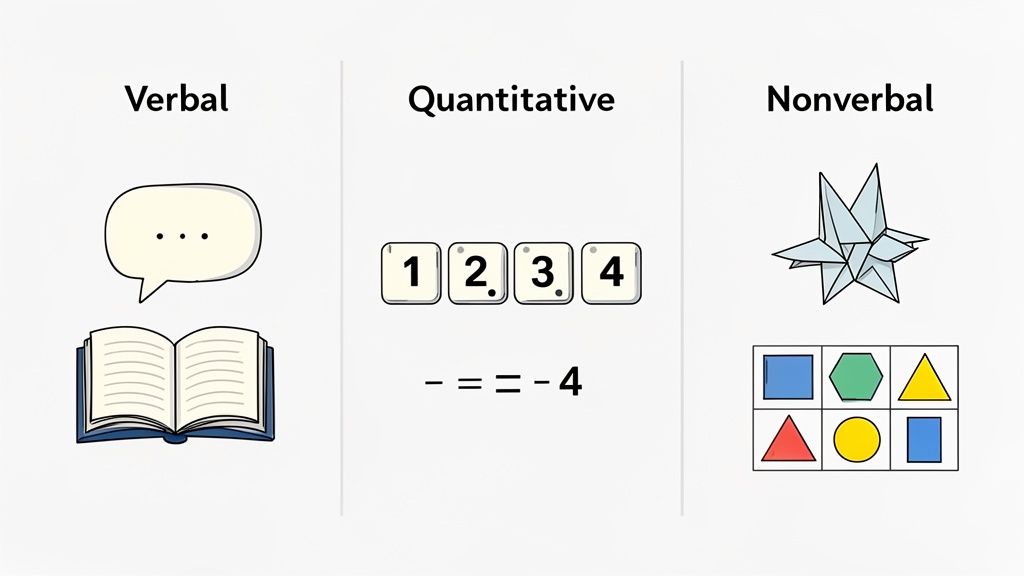
This way, you are always strengthening the underlying reasoning abilities, not just teaching to the test.
Targeting the CogAT Verbal Battery
The Verbal Battery measures more than vocabulary; it assesses flexibility and precision with language. It gauges the ability to understand the relationships between concepts, a critical skill for academic success.
Let's say a diagnostic assessment identifies a micro-category weakness in Verbal Analogies, even though your child is a voracious reader. This is a common scenario. A child might have a large vocabulary but struggle to pinpoint the specific relationship between two words. Is it part-to-whole? Cause-and-effect? Object-to-function?
You can address this directly with targeted practice:
- Create Your Own Analogies: Instead of only solving analogies, have your child create them. Give them a pair like "leaf : tree" and ask them to invent another pair that shares the same "part of the whole" relationship, such as "finger : hand." This active creation reinforces relational patterns.
- Level-Up Sentence Completion: Move beyond simple fill-in-the-blanks. Craft complex sentences where the missing word must be inferred from logic and context, just like in the Sentence Completion subtest. For example: "Because the scientist wanted to observe the tiny organism, she needed a ___."
Honing Skills for the Quantitative Battery
This battery is less about calculation and more about quantitative reasoning and problem-solving abilities. The primary focus is on pattern recognition in numbers and symbols. A child might excel at multiplication but get stuck finding the pattern in a number series.
If your diagnostic points to a weakness here, you can integrate these activities into your day:
- Daily Number Series Puzzles: Make these a regular warm-up. Start simply (2, 4, 6, 8, __) and gradually increase complexity by introducing multiple operations. Think "multiply by 2, add 1" patterns, like in the series 2, 5, 11, 23, __.
- Equation-Building Games: Give your child a set of numbers (like 2, 4, 5, 10) and a target number (like 20). Challenge them to build an equation to reach the target, such as "(4 x 5) + 2 - 2 = 20." This builds the flexible thinking required for Number Puzzles.
For more ideas and materials, our guide to the best CogAT practice resources for elementary students is packed with targeted strategies.
Mastering the Nonverbal Battery
The Nonverbal Battery is often the most challenging for students. It measures abstract and spatial reasoning using geometric shapes and figures, skills that are rarely taught directly in a standard curriculum. This makes dedicated practice absolutely essential.
A diagnostic might pinpoint a very specific struggle, such as with Paper Folding tasks that involve diagonal folds versus simpler horizontal ones.
The Nonverbal Battery is where the value of a diagnostic approach becomes crystal clear. Without it, you are simply guessing at which of the many complex spatial skills your child might be struggling with.
Here is how you can build these abstract skills with tangible, hands-on activities:
- Origami for Paper Folding: The simple act of following instructions to fold paper into a shape provides direct practice for the Paper Folding subtest. It transforms abstract spatial rotation into something concrete and understandable.
- Logic and Matrix Puzzles: Use games like Sudoku or other commercially available logic puzzles for children. These directly train the brain to find missing elements in a grid based on rules and patterns, the core skill for Figure Matrices. Start with simple 3x3 grids and work your way up.
By embedding these CogAT-aligned activities into your homeschool curriculum, you shift the focus from rote memorization to deep cognitive skill development. This integrated strategy not only prepares your child for the test but also builds a more agile and analytical thinker for the long term.
A Sample Week With a Diagnostic-Driven Approach
General advice is one thing, but seeing how it works in practice is another. Let's make this practical by walking through a sample week for a hypothetical gifted 2nd grader, "Leo."
Imagine Leo’s GiftedPrep diagnostic report reveals a common profile. He is in the 98th percentile on the Verbal Battery, which is excellent. However, his Nonverbal score is at the 65th percentile. The data points to a specific micro-category weakness: Nonverbal Figure Classification questions.
This report is our roadmap. Our mission becomes clear: continue to foster Leo’s verbal talents while using targeted practice to sharpen his abstract pattern recognition skills. The generic, one-size-fits-all curriculum is no longer an option.
Setting the Stage for Surgical Precision
Armed with this data, we can design a week that is balanced, engaging, and highly effective. We will leverage his verbal strength to build confidence and maintain his love for learning, while strategically embedding short, focused sessions to address his nonverbal weakness. This is not about tedious drills; it is about 15-20 minutes of the right kind of practice each day.
Integration is key. The targeted work on Figure Classification will not feel like a chore. We will frame it as a fun puzzle or a brain-training game, weaving it seamlessly into a day filled with activities he already enjoys.
A diagnostic-driven schedule does not add more work; it directs the work that is already being done. It ensures every learning activity serves a purpose in building a well-rounded thinker.
This approach transforms the homeschool curriculum for gifted students from a guess into a smart, calculated strategy. Below is a detailed plan showing how Leo's diagnostic results translate into a real week of learning.
Sample Weekly Plan Based on Diagnostic Results
This schedule shows how to blend core subjects with targeted practice for a student who is strong verbally but needs support with Nonverbal Figure Classification.
| Day | Core Subject Focus (Language Arts/Math) | Targeted Gifted Practice (15-20 mins) | Enrichment Activity |
|---|---|---|---|
| Monday | Language Arts: Dive into an advanced chapter book, focusing on character motivation and predicting outcomes. | Figure Classification: Work through 5-7 GiftedPrep practice questions on identifying the rule that groups three shapes. | Creative Writing: Write an alternate ending to the chapter, playing to his verbal strengths. |
| Tuesday | Math: Explore multiplication concepts with hands-on manipulatives and real-world story problems. | Pattern Sorting: Use attribute blocks (different shapes, colors, sizes) to create and identify sorting rules (e.g., "all red triangles"). | Logic Puzzles: Complete a few simple Sudoku or KenKen puzzles to build logical deduction skills. |
| Wednesday | Language Arts: Create custom Verbal Analogies. Start with "leaf is to tree as..." and have him create related pairs. | "Which One Doesn't Belong?": Play a visual game with everyday objects, asking him to explain why one item does not fit the group. | Science Experiment: Conduct a simple kitchen science experiment, focusing on observation and recording results. |
| Thursday | Math: Work on a multi-step word problem, like planning a budget for a pretend pet store. | Figure Classification: Use a puzzle app or workbook that requires identifying patterns in abstract designs. | Block Building Challenge: Replicate complex 2D patterns with 3D blocks, a great hands-on way to practice spatial reasoning. |
| Friday | Review & Play: Review the week's math concepts through a fun board game. | Timed Practice: Complete a short, timed set of 5 Figure Classification questions to build speed and confidence. | Free Exploration: Visit the library or a museum to let him follow his own curiosities, nurturing his natural love of learning. |
This weekly structure is a flexible template, not a rigid mandate. The core principle is what matters: play to your child’s strengths to build confidence while systematically addressing weaknesses with short bursts of targeted practice. This diagnostic-driven method ensures you are building a complete thinker, ready for future challenges.
How to Monitor Progress and Adjust Your Plan
A powerful, data-driven homeschool curriculum for gifted students is never a static document. It is a living blueprint that must evolve with your child. Once you begin targeted practice, the question "Is this working?" will arise. The key is to monitor progress in a way that goes beyond simply counting correct answers.
True progress for a gifted child is not just about accuracy; it is about efficiency and independence. Are they solving problems faster? Are they beginning to see the underlying patterns in figure matrices without prompting? This indicates that genuine cognitive skills are developing, not just rote memorization.
Moving Beyond Simple Score Tracking
Your monitoring must be as precise as your curriculum. Instead of using broad assessments, track improvement within the specific micro-category weakness you identified. Look for tangible evidence that their thought process is growing stronger.
Here are the key metrics to watch:
- Speed: Is your child now finishing a set of five number analogies in three minutes instead of five? This is a clear sign of improved fluency.
- Independence: Are they identifying the core pattern on their own, when a month ago you had to provide hints?
- Strategy: Can they explain why an answer is correct? Articulating their reasoning is a strong indicator of deep comprehension.
The Re-Assessment and Adjustment Cycle
The diagnostic approach is cyclical. After a period of focused, targeted practice, it is time to re-assess. This step provides the hard data needed to adjust your plan confidently.
This data-driven cycle of assess, practice, and re-assess transforms your homeschooling from guesswork into a clear, strategic process. It provides concrete proof that your efforts are producing real results, which helps ease the anxiety of high-stakes test preparation.
For example, if your initial diagnostic showed a weakness in paper folding and after six weeks of targeted practice your child is now scoring in the 90th percentile on those questions, that is a clear victory. You can now pivot with confidence. Your next diagnostic check-in might reveal it is time to shift focus to a different micro-category, perhaps in the Quantitative battery. This ensures you are always addressing the area of greatest need, making every moment of instruction count. Understanding how these scores translate is crucial; our guide on what CogAT percentile rankings mean can provide essential context for your tracking.
This constant, data-informed adjustment is the heart of an effective program. It is the difference between blindly practicing and intelligently preparing your child for success.
Frequently Asked Questions About Gifted Homeschooling
When homeschooling a gifted child for competitive admissions, questions are inevitable. You need direct answers without the fluff. Here are straightforward responses to the most common concerns from parents in your position.
Should I Use a Boxed Curriculum or Build My Own?
A boxed curriculum is tempting because it feels safe. However, it is rarely the right fit for a gifted learner’s unique cognitive profile. Your child might be advanced in verbal skills but have a hidden micro-category weakness in a nonverbal area like Paper Folding. A one-size-fits-all curriculum will miss that completely.
I almost always recommend building your own framework on one critical condition: it must be built on a diagnostic foundation. This allows you to select resources with surgical precision, providing enrichment where your child is strong and targeted practice for specific weak spots. This is the only way to prevent boredom while closing learning gaps.
How Much Time Should We Spend on Test Prep?
The most effective "test prep" does not feel like test prep at all. The best results come from weaving skill-building directly into daily lessons. A diagnostic-driven plan makes this a natural process.
For instance, if a diagnostic shows a weakness in Number Analogies, you would not schedule an hour of drills. Instead, you would seamlessly integrate 15 minutes of number pattern games and logic puzzles into your daily math block.
This approach turns your homeschool curriculum for gifted students into a system that naturally strengthens the cognitive skills measured by tests like the CogAT. By incorporating exercises in areas like pattern recognition into your regular routine, preparation becomes a consistent, low-stress habit, not a frantic last-minute effort.
Ready to stop guessing and start building a curriculum with surgical precision? The GiftedPrep diagnostic engine pinpoints your child's exact cognitive weaknesses, providing a personalized roadmap for targeted practice. Discover your child’s learning blueprint at https://giftedprep.com.